

How Does a Home EV Charger Actually Work? (Level 1 vs Level 2 Basics)
Short answer: a home EV charger simply controls and delivers electricity from your home’s wiring to your car’s onboard charger, and the speed comes down to whether you’re plugged into a standard 120V outlet (Level 1) or a dedicated 240V circuit (Level 2).
Quick answer: Level 1 charging uses the standard 120V outlet and cable that typically comes with your EV and adds a few miles of range per hour. Level 2 charging uses a 240V circuit and a dedicated charging unit, adding roughly 20 to 40 miles of range per hour depending on the vehicle and equipment.
Level 1 vs. Level 2: what’s actually different
Both Level 1 and Level 2 charging deliver alternating current (AC) power that your EV’s onboard charger converts to direct current (DC) to store in the battery. The difference isn’t the technology inside the car, it’s how much power the outlet or circuit can deliver. A standard household outlet is limited to around 120 volts and modest amperage, while a 240V circuit (the same voltage class as a dryer or range) can push meaningfully more power to the car per hour.
That’s why Level 1 charging is often described as trickle charging. It works fine for plug-in hybrids or drivers with very short daily commutes who can charge overnight, but for most full battery-electric vehicles it can take a day or more to go from a low charge to full. Level 2 closes that gap significantly and is what most homeowners end up installing once they’re driving an EV as a daily vehicle.
What a Level 2 install actually involves
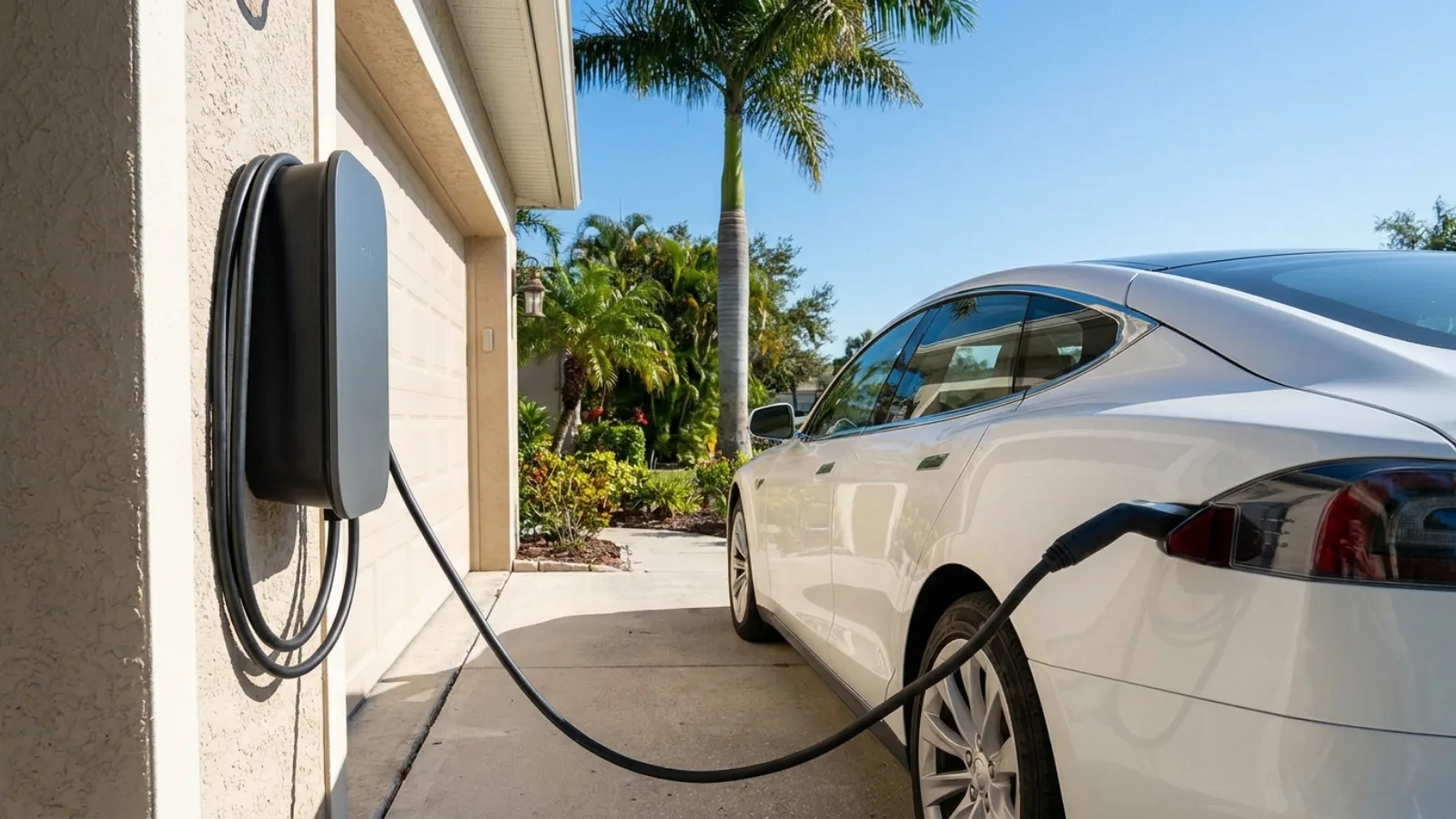
A Level 2 setup requires a dedicated 240V circuit run from your electrical panel to a charging location, typically the garage or driveway, along with a charging unit (sometimes called EVSE, or electric vehicle supply equipment) mounted at that location. An electrician sizes the circuit and breaker to match the charger’s amperage rating and confirms your panel has the capacity to support it.
Some homeowners are surprised to learn the ‘charger’ in the garage isn’t actually charging the battery directly, it’s a safety and communication device that manages the connection between your home’s wiring and the car’s onboard charger. That’s part of why proper installation matters. It’s an electrical safety component, not just a convenience accessory.
Which one makes sense for your household
If you drive under roughly 30-40 miles a day and can plug in every night, Level 1 charging may genuinely be enough, especially for a plug-in hybrid. If you drive more, share one charger between multiple EVs, or want the flexibility to fully recharge overnight regardless of how depleted the battery is, Level 2 is generally the more practical long-term choice.
The right answer really depends on your specific commute, vehicle, and panel capacity, which is why we walk through actual usage patterns with homeowners rather than making a blanket recommendation. It’s also worth thinking about this alongside any plans for solar or battery storage, since those systems interact with how and when you charge.
See what solar and battery storage would actually do for your home
We will pull your last 12 months of utility data, model your real consumption, and show you exactly what a system would cost and produce — no obligation, no pressure.
Frequently asked questions
Can I just use the cable that came with my EV?
Most EVs ship with a Level 1 cable that plugs into a standard outlet, so yes, you can start there. Many drivers later upgrade to a Level 2 charger for faster charging, but it depends on your daily mileage and how much time you have to charge overnight.
Does a Level 2 charger require a permit?
In most jurisdictions, yes, since it involves a new dedicated circuit tied into your electrical panel. Your installer should handle permitting and inspection as part of the installation process.
How fast is Level 2 charging really?
It varies by vehicle and charger amperage, but a common range is roughly 20 to 40 miles of range added per hour, which is generally enough to fully recharge most EVs overnight.
Can I install a Level 2 charger myself?
We don’t recommend it. It involves a dedicated high-voltage circuit tied to your main panel, and improper installation is a real safety and fire risk, so this should be done by a licensed electrician.
Do all EVs use the same charging plug?
Plug standards vary somewhat by manufacturer and region, and this has been evolving as automakers shift toward common connector standards, so it’s worth confirming compatibility for your specific vehicle when planning an installation.
Related guides
- Bidirectional EV chargers
- Do you need a panel upgrade for a home EV charger?
- What is a bidirectional EV charger?
- Battery storage
- Get a free energy evaluation
Figures on this page are typical industry averages for planning purposes and assume Florida’s 14.5¢/kWh average residential rate and 5.5 peak-sun hours per day. Your actual numbers will differ based on your utility, roof, and system — request a free evaluation for figures specific to your home.