
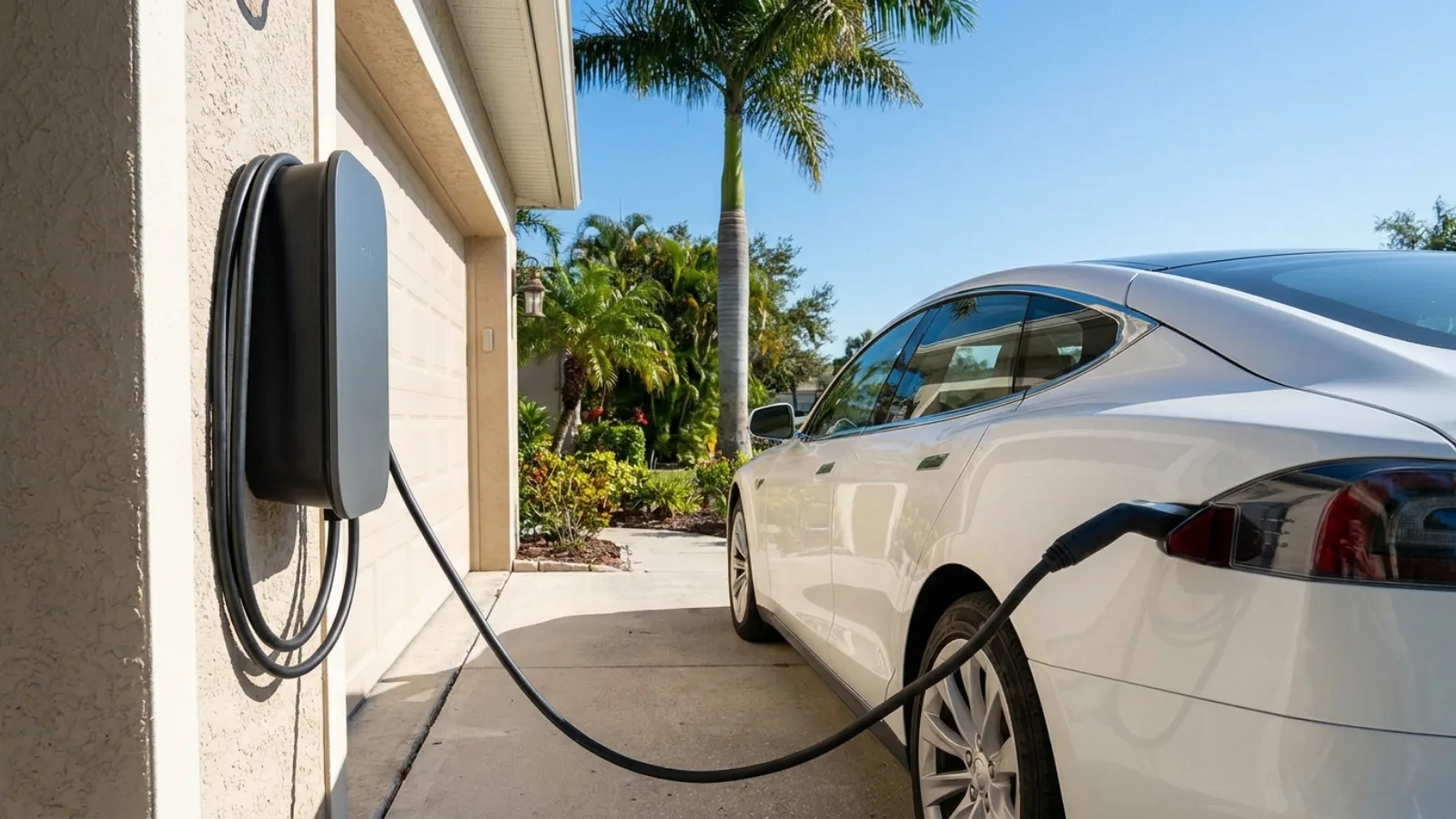

What Is a Bidirectional EV Charger and How Is It Different From a Standard One?
Short answer: a standard EV charger only sends power in one direction, from your home into the car, while a bidirectional charger can also pull power back out of a compatible EV’s battery to power your home or, in some setups, feed it back to the grid.
Quick answer: A bidirectional charger adds hardware and controls that let electricity flow both ways between your car and your home, turning a compatible EV into a large mobile battery that can supplement or replace stationary battery storage for backup power.
One-way vs. two-way power flow
A standard Level 2 charger is built around a single job, taking AC power from your home’s circuit and handing it to the car’s onboard charger to top up the battery. The electrical path only runs one direction, and the hardware inside is generally simpler and less expensive because of it.
A bidirectional charger adds the equipment needed to reverse that flow safely, converting DC power from the car’s battery back into usable AC power for your home. This is meaningfully more complex than standard charging, since it has to manage that conversion, sync with your home’s electrical system, and often coordinate with the grid connection.
What you actually need for this to work
Bidirectional charging isn’t just about the charger unit, it depends on the vehicle too. Not every EV on the market supports vehicle-to-home or vehicle-to-grid functionality, since the car’s own battery management and onboard electronics need to support two-way power flow. This is one of the first things to confirm before considering a bidirectional setup.
On the home side, the installation typically involves the bidirectional charging unit itself along with equipment to manage how that power integrates with your home’s panel and, in many cases, your existing solar or battery system, so it works as one coordinated setup rather than several disconnected pieces.
Why homeowners are interested in this
The main draw is flexibility. A compatible EV often has a larger battery than most stationary home battery systems, so a bidirectional charger can turn that capacity into meaningful backup power during an outage, or potentially help offset peak electricity usage depending on how your utility structures rates.
It’s a newer category of equipment compared to standard EV charging or stationary battery storage, so availability, vehicle compatibility, and utility program rules are all things we walk through with homeowners individually rather than assuming they apply the same way to every situation.
See what solar and battery storage would actually do for your home
We will pull your last 12 months of utility data, model your real consumption, and show you exactly what a system would cost and produce — no obligation, no pressure.
Frequently asked questions
Does every EV support bidirectional charging?
No. Vehicle-to-home and vehicle-to-grid capability depends on the car’s onboard electronics and battery management system, so it’s worth confirming compatibility for your specific EV before planning a bidirectional installation.
Is a bidirectional charger more expensive than a standard Level 2 charger?
Generally yes, since the hardware has to manage two-way power conversion rather than a single direction, which adds cost and complexity to both the equipment and the installation.
Can a bidirectional charger replace a stationary home battery?
For some homeowners it can serve a similar backup role, though the two work differently and can also complement each other. Which setup makes sense depends on your vehicle, driving habits, and backup power goals.
Does a bidirectional charger work with solar panels?
Yes, in many configurations a bidirectional charger, solar system, and stationary battery can all be coordinated together, though the specific integration depends on your equipment and is something we plan as part of the system design.
Can I add bidirectional capability later if I start with a standard charger?
In some cases, though it typically means additional equipment and installation work rather than a simple software upgrade, so it’s worth discussing your longer-term plans upfront if bidirectional charging is something you’re considering.
Related guides
- Bidirectional EV chargers
- Can a bidirectional EV charger power your home during an outage?
- How does a home EV charger actually work?
- Battery storage
- How does solar battery storage work?
Figures on this page are typical industry averages for planning purposes and assume Florida’s 14.5¢/kWh average residential rate and 5.5 peak-sun hours per day. Your actual numbers will differ based on your utility, roof, and system — request a free evaluation for figures specific to your home.