
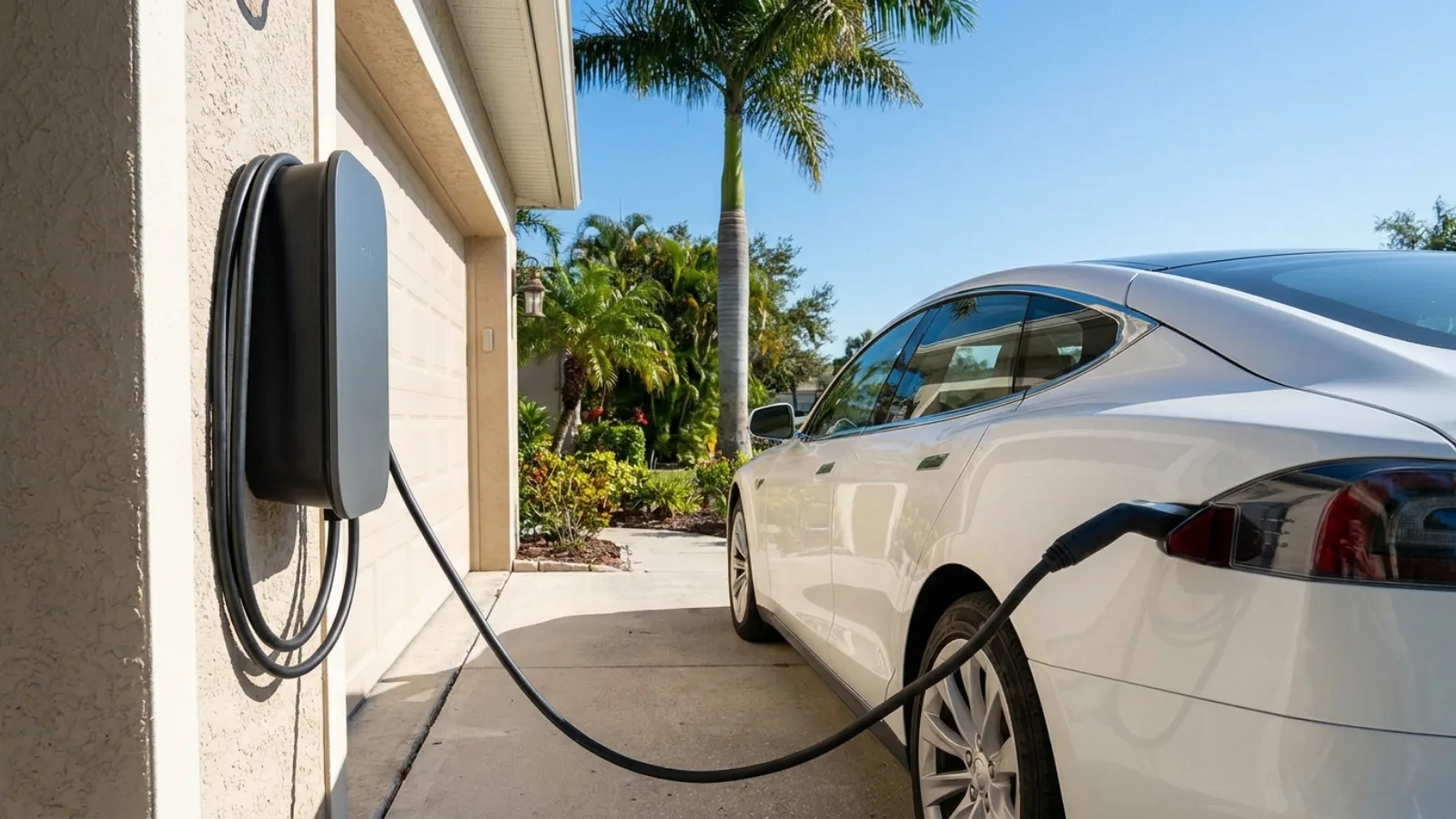

How Much Does It Cost to Charge an EV at Home vs. a Public Charging Station in Florida?
Short answer: charging at home is generally the cheaper option on a per-charge basis because you’re paying your regular residential electricity rate, while public charging stations, especially DC fast chargers, typically charge a premium for speed and convenience.
Quick answer: Home charging costs are based on your utility’s residential electricity rate and the kWh your EV actually draws, while public charging stations often price by the minute or at a higher per-kWh rate that reflects the cost of fast-charging infrastructure, making home charging the lower-cost default for most drivers.
How home charging costs are calculated
The cost of charging at home comes down to two numbers: how many kWh your EV’s battery actually needs, and your utility’s per-kWh residential rate. Multiply those together and you have a rough cost per charge, which for most EVs and most Florida utility rates works out to meaningfully less than a comparable amount of gasoline.
Some utilities also offer time-of-use rate plans, where electricity costs less during off-peak hours, often overnight. If your plan includes this, scheduling EV charging for those hours can lower your cost further, though the specific savings depend entirely on your utility’s rate structure, which is worth reviewing with your installer or utility directly.
How public charging pricing works differently
Public charging stations, particularly DC fast chargers, are priced to reflect the cost of the infrastructure and the convenience of a fast charge, and pricing models vary a lot between networks. Some charge per kWh, others charge per minute of connection time, and rates can also vary by location and even by time of day or membership tier.
Because of this, a full charge at a public fast charger is typically more expensive than an equivalent overnight charge at home, sometimes considerably so. Public charging still plays an important role for road trips or when you’re away from home, but it isn’t usually the economical choice for routine daily charging.
Why home charging is the practical default for most drivers
Beyond cost, home charging is simply more convenient for most people, since it happens overnight while the car is already parked, rather than requiring a stop at a public station. This is a big part of why most EV owners do the vast majority of their charging at home and treat public charging as a supplement for travel.
If you’re weighing whether a home charger is worth installing, it’s worth thinking about your actual driving pattern rather than a single average figure. Someone who commutes daily and charges overnight will see very different economics than someone who rarely drives, and we walk through that specific comparison as part of an evaluation.
See what solar and battery storage would actually do for your home
We will pull your last 12 months of utility data, model your real consumption, and show you exactly what a system would cost and produce — no obligation, no pressure.
Frequently asked questions
Is home EV charging always cheaper than public charging?
In most cases yes, since you’re paying your standard residential rate rather than a premium fast-charging rate, though the exact difference depends on your utility’s rates and the specific public charging network’s pricing.
Do time-of-use electricity rates help with EV charging costs?
They can, if your utility offers a time-of-use plan and you’re able to shift charging to off-peak hours, though the actual savings depend on your specific rate plan, which is worth reviewing with your utility.
Why do public fast chargers cost more than home charging?
Fast chargers require significant infrastructure investment and deliver much higher power levels, and that cost is generally reflected in higher per-kWh or per-minute pricing compared to overnight home charging.
Does charging from solar panels reduce my EV charging costs further?
It can, to the extent your charging draws from solar production instead of the grid, though the actual savings depend on your system size, your charging schedule, and how much of your home’s other usage the system is also covering.
How do I estimate what home EV charging will cost me?
The most accurate approach is to look at your vehicle’s battery size, your typical daily driving distance, and your utility’s residential rate, which is something we can walk through with you as part of a broader energy evaluation.
Related guides
- How does time-of-use pricing affect solar savings?
- Solar systems
- How does a home EV charger actually work?
- Florida solar by city
- Get a free energy evaluation
Figures on this page are typical industry averages for planning purposes and assume Florida’s 14.5¢/kWh average residential rate and 5.5 peak-sun hours per day. Your actual numbers will differ based on your utility, roof, and system — request a free evaluation for figures specific to your home.