

What Is the High-Velocity Hurricane Zone and How Does It Affect Solar?
Short answer: the High-Velocity Hurricane Zone covers Miami-Dade and Broward counties, and inside it every part of a solar mounting system needs specific approval documentation and engineered attachment details that the rest of Florida does not require.
Quick answer: The High-Velocity Hurricane Zone, usually shortened to HVHZ, is a section of the Florida Building Code applying to Miami-Dade and Broward counties. It imposes the strictest product testing and structural documentation requirements in the country, and it is why a solar permit in Miami takes a different route from the same job in Tampa.
The HVHZ exists because South Florida sits in the path of the strongest storms to reach the United States mainland, and because Hurricane Andrew in 1992 exposed how badly ordinary construction performed. The result is a building code that tests products harder and documents installations more heavily than anywhere else. For solar, that shows up in three places: what hardware you are allowed to use, how it must be attached, and how much of that has to be proven on paper before a permit is issued.
What changes inside the HVHZ
| Requirement | Inside HVHZ (Miami-Dade, Broward) | Rest of Florida |
|---|---|---|
| Product approval | Miami-Dade Notice of Acceptance is generally expected for mounting components | Statewide Florida Product Approval is normally sufficient |
| Attachment detail | Engineer-sealed details showing fastener type, embedment and spacing for your roof | Sealed drawings required, with less prescriptive detail in many jurisdictions |
| Plan review | Line-by-line review of approval documentation and uplift calculations | Structural and electrical review against the code |
| Roof interaction | Tighter rules on penetrations, flashings and existing covering condition | Standard code requirements |
| Inspection | Attachment frequently verified before it is covered | Verified at final inspection in most jurisdictions |
What this means for you as a homeowner
- Expired documentation is the number one delay. Notices of Acceptance carry expiry dates. A submittal built on an approval that lapsed last quarter gets rejected, and the fix is a redesign, not a resubmission.
- Not every racking system is HVHZ-approved. Hardware that is perfectly legal in Orlando may have no path to approval in Broward. The design has to start from what is approved, not from what is cheapest.
- Your roof condition matters more here. Attachment strength depends on what the fastener lands in. Deteriorated sheathing or undersized framing turns into a structural repair before the array can go up.
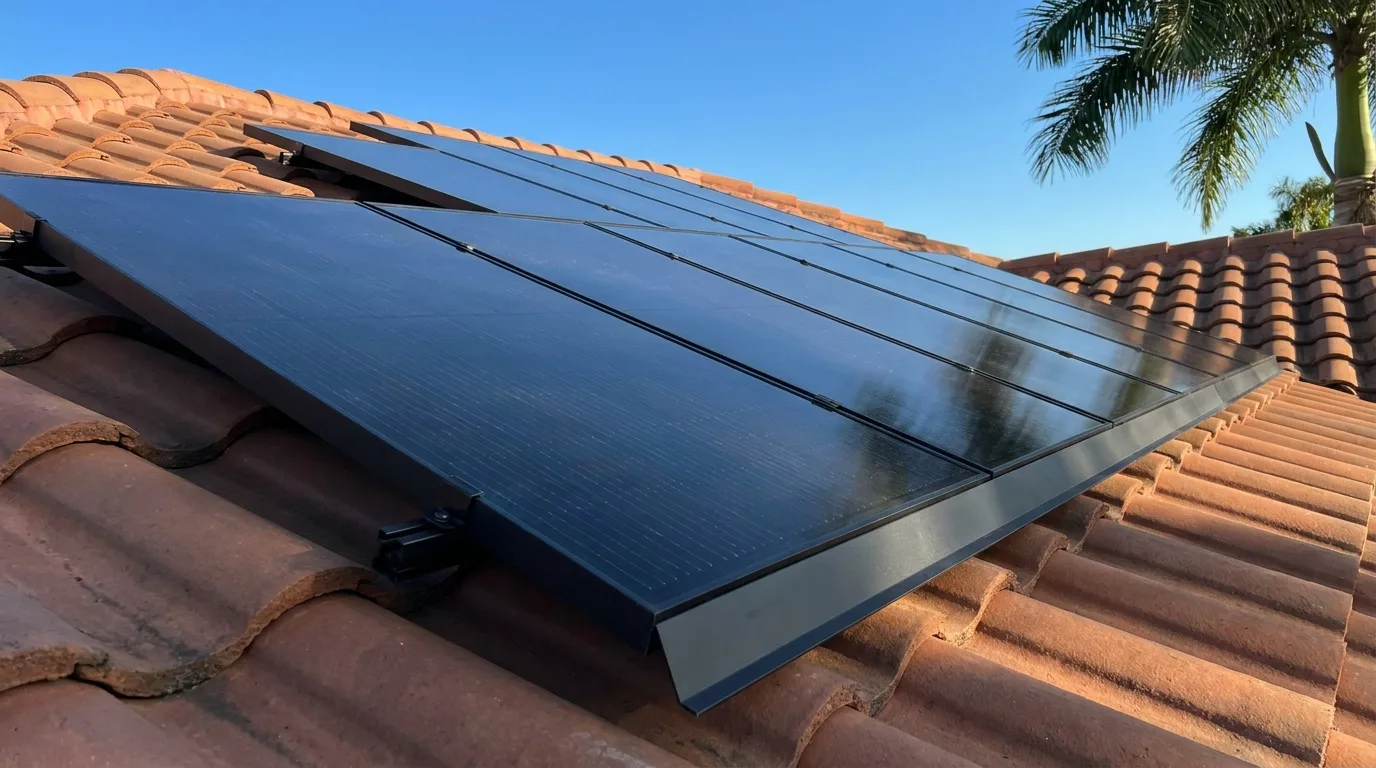
- Tile roofs need specific detailing. South Florida has a great deal of concrete and clay tile. Tile-replacement flashings and correct load transfer are routine work, but they have to be drawn and approved, not improvised.
- It is a quality floor, not just red tape. An HVHZ-compliant array is engineered to stay on the roof in conditions most of the country never sees. That is worth having.
What we handle for you
We design to the approval documentation that is current on the day we submit, produce the sealed attachment details your jurisdiction expects, and carry the permit through plan review and inspection ourselves.
See what solar and battery storage would actually do for your home
We will pull your last 12 months of utility data, model your real consumption, and show you exactly what a system would cost and produce — no obligation, no pressure.
Frequently asked questions
Which counties are in the High-Velocity Hurricane Zone?
Miami-Dade and Broward. The rest of Florida follows the standard Florida Building Code, which is still far stricter than most of the country.
Does HVHZ apply to solar panels or just to roofs?
It applies to the whole assembly. The modules, the racking, the fasteners and the flashings all form part of the roof system, and all of it is reviewed.
Can I use any racking system in Miami-Dade?
No. The mounting system needs current approval documentation acceptable to the jurisdiction, which in practice narrows the options considerably.
Does HVHZ make solar more expensive?
It adds engineering and documentation, and it limits hardware choice. It also produces an installation that is genuinely built for the conditions.
Is Palm Beach County in the HVHZ?
No. Palm Beach sits just outside it, so statewide Florida Product Approval is generally accepted, although design wind speeds near the coast remain high.