
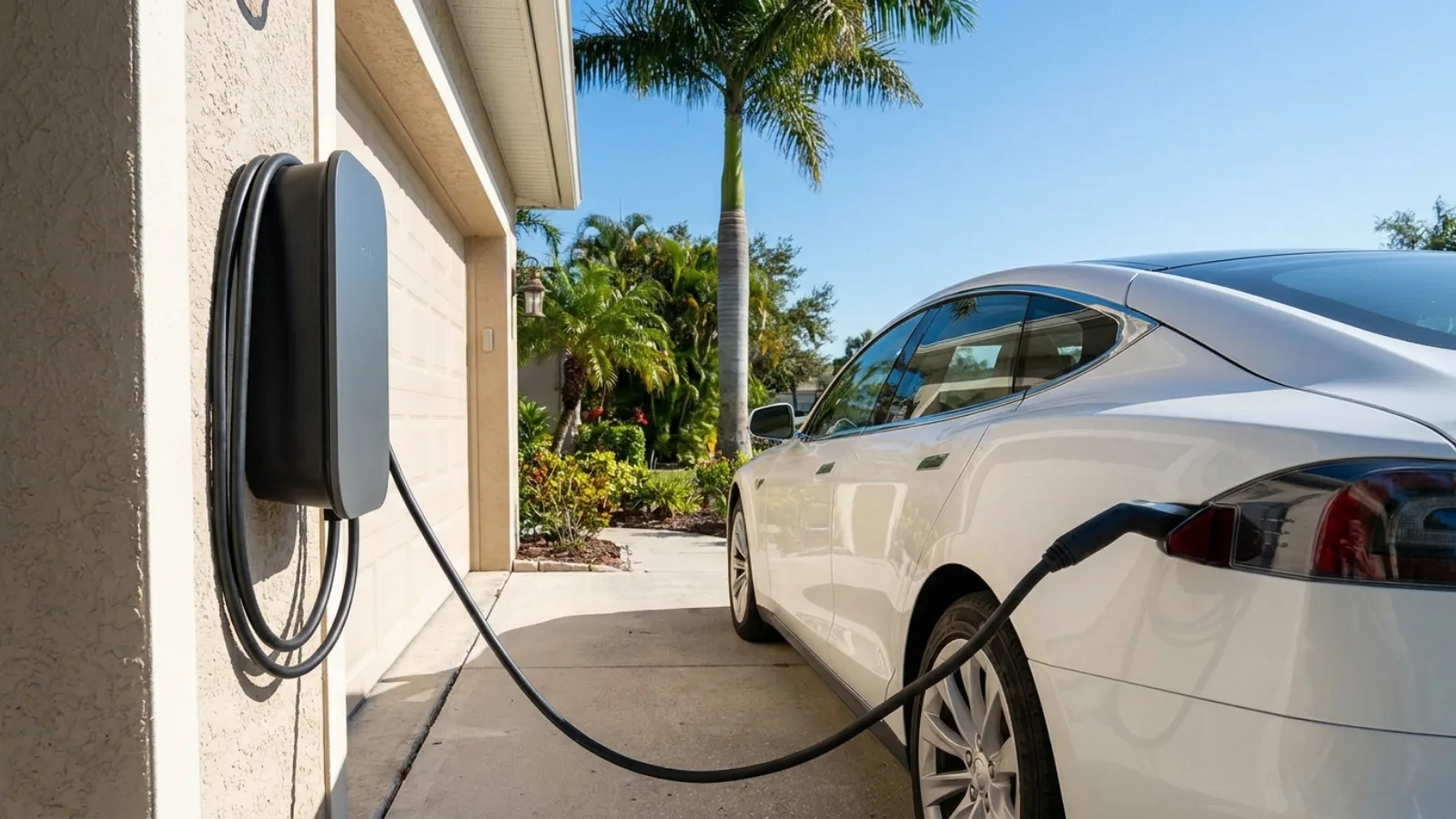

Can a Bidirectional EV Charger Power Your Home During an Outage?
Short answer: yes, with a compatible EV and the right bidirectional charging equipment, vehicle-to-home (V2H) technology can use your car’s battery to power your home during an outage, often with significantly more stored capacity than a typical stationary home battery.
Quick answer: Vehicle-to-home charging reverses the normal charging flow, letting a compatible EV’s battery, which is often several times larger than a stationary home battery, supply power back into your home through a bidirectional charger during an outage.
How V2H differs from standard EV charging and V2G
Vehicle-to-home (V2H) is one form of bidirectional charging, specifically focused on powering your home directly from your EV’s battery. It’s related to but distinct from vehicle-to-grid (V2G), which sends power from the car back to the utility grid rather than to your home, and typically involves different equipment, programs, and utility coordination.
For backup power purposes, V2H is the relevant capability, since it lets your EV act similarly to a large stationary battery, powering your home’s circuits when the grid goes down, without needing to feed power back to the utility at all.
What’s actually required to make this work
This starts with a compatible EV, since not all vehicles support bidirectional power flow, and continues with a bidirectional charging unit and any additional equipment needed to safely manage how that power integrates with your home’s electrical panel during an outage.
Because this is a more complex and newer setup than standard EV charging or even standard battery storage, it’s worth having your installer confirm vehicle compatibility and equipment requirements specifically for your situation before assuming it will work with your particular EV and home.
How it compares with and complements stationary battery storage
A compatible EV often has a considerably larger battery than a typical stationary home battery system, which means V2H can potentially offer more backup capacity in some scenarios. That said, your car needs to be home and charged for this to work, which is a real practical difference from a stationary battery that’s always connected and ready.
Some homeowners view V2H as a complement to, rather than a replacement for, stationary battery storage, since the two have different tradeoffs around availability, capacity, and how they integrate with solar. This is very much a case-by-case conversation depending on your vehicle, driving habits, and backup power goals.
See what solar and battery storage would actually do for your home
We will pull your last 12 months of utility data, model your real consumption, and show you exactly what a system would cost and produce — no obligation, no pressure.
Frequently asked questions
Do I need a special charger for vehicle-to-home power?
Yes, standard Level 2 chargers only send power one direction into the car. Vehicle-to-home requires a bidirectional charging unit and compatible vehicle to reverse that flow safely.
Can any EV do vehicle-to-home charging?
No, this depends on the vehicle’s onboard electronics and battery management system supporting bidirectional power flow, so compatibility needs to be confirmed for your specific EV model.
Is vehicle-to-home the same as vehicle-to-grid?
They’re related but different. Vehicle-to-home sends power from your EV to your house, while vehicle-to-grid sends power back to the utility grid, and each typically involves different equipment and programs.
Can I use V2H and a stationary battery together?
In many cases yes, and some homeowners use both to complement each other’s strengths, though this requires proper system design to coordinate how the two sources of backup power work together.
What happens if my car isn’t home during an outage?
Vehicle-to-home power is only available when your EV is connected to the bidirectional charger, so it can’t provide backup if the car is away from home, which is a key difference from a stationary battery system.
Related guides
- Bidirectional EV chargers
- What is a bidirectional EV charger?
- Battery storage vs. a gas generator: which makes more sense?
- Battery storage
- Get a free energy evaluation
Figures on this page are typical industry averages for planning purposes and assume Florida’s 14.5¢/kWh average residential rate and 5.5 peak-sun hours per day. Your actual numbers will differ based on your utility, roof, and system — request a free evaluation for figures specific to your home.