

.tce-blog{font-family:Inter,sans-serif;color:#1f2937}.tce-blog-hero{background:linear-gradient(135deg,#0959A8,#2FA824);padding:70px 55px;border-radius:30px;color:#fff;margin-bottom:40px}.tce-blog-author{display:inline-block;padding:10px 18px;background:rgba(255,255,255,.15);border-radius:50px;font-size:14px;font-weight:600;margin-bottom:20px}.tce-blog-hero h1{font-family:Poppins,sans-serif;font-size:50px;line-height:1.12;font-weight:800;color:#fff;margin:0 0 18px}.tce-blog-hero p{font-size:20px;line-height:1.7;max-width:820px;margin:0}.tce-blog-content{background:#fff;padding:2px 50px 50px;border-radius:30px;box-shadow:0 15px 50px rgba(0,0,0,.06)}.tce-blog-content p{font-size:18px;line-height:1.9;color:#4b5563;margin-bottom:25px}.tce-blog-content h2{font-family:Poppins,sans-serif;font-size:32px;font-weight:700;color:#0959A8;margin:50px 0 20px}.tce-blog-content h3{font-family:Poppins,sans-serif;font-size:22px;font-weight:700;color:#0e2a1d;margin:32px 0 12px}.tce-blog-content li{font-size:18px;line-height:1.85;color:#4b5563;margin-bottom:10px}.tce-highlight{background:#f7fbff;border-left:5px solid #2FA824;padding:25px;border-radius:0 14px 14px 0;margin:30px 0}.tce-highlight p{margin:0!important;font-size:18px!important;color:#1f2937!important}.tce-tbl{width:100%;border-collapse:collapse;margin:26px 0;font-size:16px}.tce-tbl th{background:#0959A8;color:#fff;text-align:left;padding:13px 15px;font-weight:700}.tce-tbl td{padding:12px 15px;border-bottom:1px solid #e5e7eb;color:#374151}.tce-tbl tr:nth-child(even) td{background:#f9fafb}.tce-cta{background:linear-gradient(135deg,#0959A8,#1f7a3d);border-radius:22px;padding:38px;color:#fff;margin:44px 0}.tce-cta h2{color:#fff!important;margin:0 0 10px!important;font-size:28px!important}.tce-cta p{color:rgba(255,255,255,.92)!important;margin:0 0 20px!important}.tce-btn{display:inline-block;background:#8ef0ae;color:#0e2a1d!important;text-decoration:none;font-weight:800;padding:13px 26px;border-radius:9px}.cpe2-faq{border-bottom:1px solid #e5e7eb;padding:20px 0}.cpe2-faq h3{margin:0 0 8px!important;font-size:19px!important;color:#0959A8!important}.cpe2-faq p{margin:0!important;font-size:17px!important}@media(max-width:768px){.tce-blog-hero{padding:40px 24px}.tce-blog-hero h1{font-size:32px}.tce-blog-content{padding:2px 22px 30px}}
{“@context”:”https://schema.org”,”@type”:”FAQPage”,”mainEntity”:[{“@type”:”Question”,”name”:”Which is better for adding a battery to existing solar?”,”acceptedAnswer”:{“@type”:”Answer”,”text”:”Generally FranklinWH, because it is AC-coupled and works alongside the solar inverter you already own. A DC-coupled hybrid like the Powerwall 3 is designed to manage solar conversion itself, so retrofitting it can mean replacing a working inverter.”}},{“@type”:”Question”,”name”:”Which is better for a brand new solar and battery install?”,”acceptedAnswer”:{“@type”:”Answer”,”text”:”The Powerwall 3 is often more efficient on a new build because the solar inverter is integrated into the battery, reducing total equipment. Whether it is the better choice still depends on backup goals and how much capacity you need.”}},{“@type”:”Question”,”name”:”Can either system power a whole Florida home?”,”acceptedAnswer”:{“@type”:”Answer”,”text”:”Both can support whole-home backup depending on how many units are installed and how the panel is configured. Whole-home backup is a function of capacity and load management rather than brand, and it needs a load calculation on your specific house.”}},{“@type”:”Question”,”name”:”Does either let me choose which circuits stay on?”,”acceptedAnswer”:{“@type”:”Answer”,”text”:”FranklinWH offers circuit-level load control through its controller, which lets you prioritise what receives battery power during an outage. This is useful in Florida where outages can run for days rather than hours.”}},{“@type”:”Question”,”name”:”How many batteries do I need?”,”acceptedAnswer”:{“@type”:”Answer”,”text”:”It depends on what you want to run and for how long. A refrigerator, lighting and one air conditioning zone is a very different requirement from a whole house including a pool pump. We size from your actual consumption rather than a rule of thumb.”}}]}
Tesla Powerwall 3 vs FranklinWH: Which Suits a Florida Home?
These two systems are built on genuinely different architectures, and that difference, not the brand, is what should decide between them.
The architectural difference that matters
The Powerwall 3 is a DC-coupled hybrid. The solar inverter is built into the battery itself, so on a new installation panels wire directly into the unit. Fewer separate components, less wall space, and one manufacturer responsible for the whole chain.
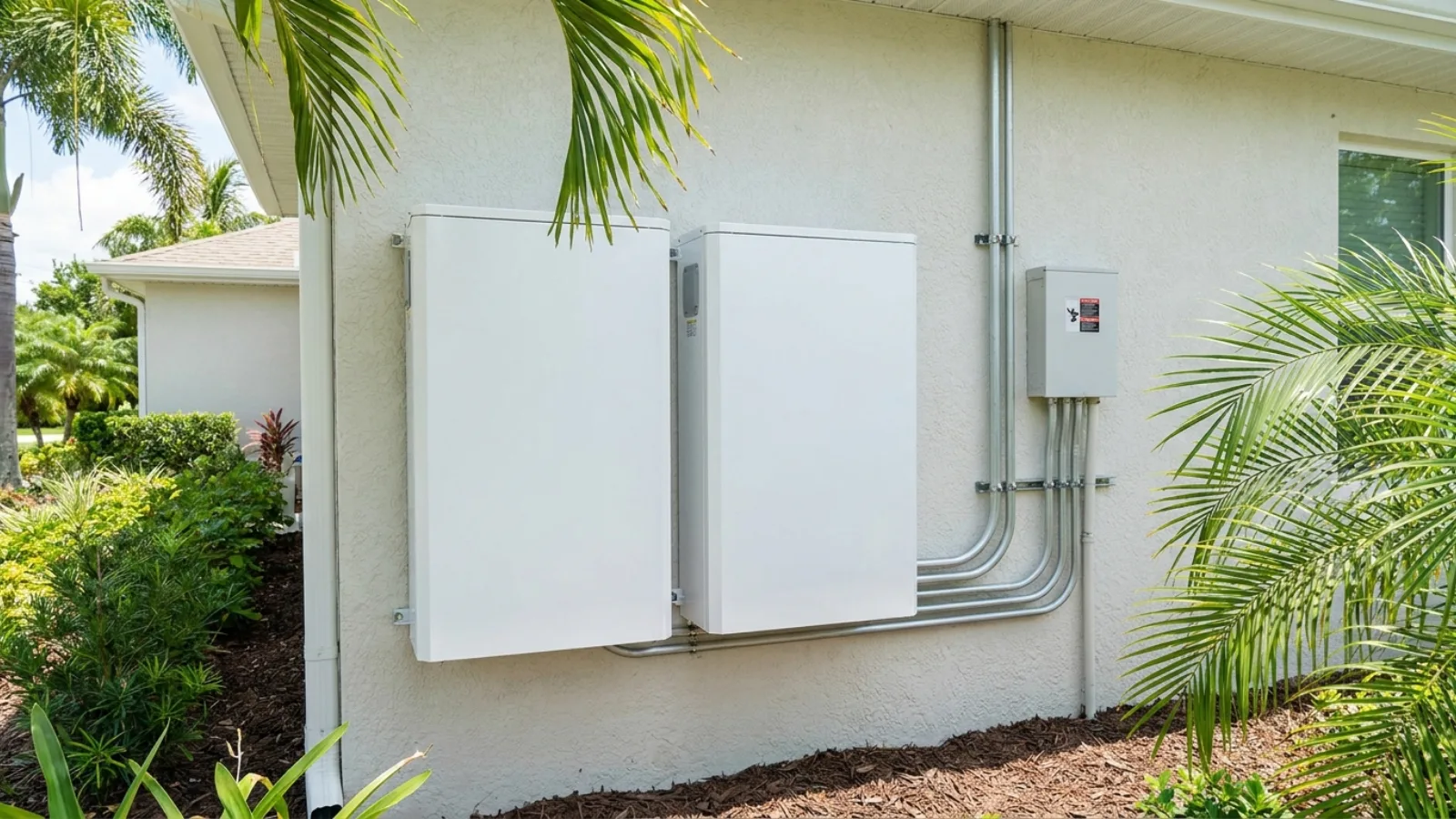
FranklinWH takes the opposite approach. The aPower battery sits behind a controller called the aGate and is AC-coupled, meaning it works with electricity your existing solar inverter has already converted.
Short version: Powerwall 3 is usually the cleaner answer when solar and battery go in together. FranklinWH is usually the better answer when there is already solar on the roof.
Adding storage to an existing system
This is where the two diverge most sharply. If you already have solar with a working inverter, AC coupling lets FranklinWH sit alongside it without replacing equipment that is doing its job. The existing inverter stays, the array stays, and the battery is added behind the controller.
Retrofitting a DC-coupled hybrid into an existing system is a bigger change, because the hybrid wants to own the solar conversion. That can mean replacing an inverter that has years of warranty left, which is money spent without adding capacity.
Scaling and load control
FranklinWH is modular. Multiple aPower units connect to a single aGate, so capacity can grow substantially for homes that need long backup runs. It also offers circuit-level control, letting you decide which loads get battery power during an outage.
That matters more in Florida than in most states. Outages here are often measured in days rather than hours, and the ability to deliberately starve a pool pump while protecting a refrigerator and a bedroom air conditioner changes how long a given battery lasts.
What actually decides it
Four questions settle most Florida decisions:
- Do you already have solar? If yes, AC coupling usually wins on cost.
- Starting from scratch? An integrated hybrid removes equipment and often lowers total installed cost.
- How long do you need to ride through? Longer requirements favour a system that scales in modules.
- Do you want load-level control? If choosing which circuits survive matters, that points one way.
Specifications change between model revisions, so confirm current capacity and power figures for the exact units being quoted rather than relying on any article, including this one.
Not sure which fits your home?
We install multiple battery platforms and have no reason to push one over another. We will model both against your actual usage and outage goals.
Frequently asked questions
Which is better for adding a battery to existing solar?
Generally FranklinWH, because it is AC-coupled and works alongside the solar inverter you already own. A DC-coupled hybrid like the Powerwall 3 is designed to manage solar conversion itself, so retrofitting it can mean replacing a working inverter.
Which is better for a brand new solar and battery install?
The Powerwall 3 is often more efficient on a new build because the solar inverter is integrated into the battery, reducing total equipment. Whether it is the better choice still depends on backup goals and how much capacity you need.
Can either system power a whole Florida home?
Both can support whole-home backup depending on how many units are installed and how the panel is configured. Whole-home backup is a function of capacity and load management rather than brand, and it needs a load calculation on your specific house.
Does either let me choose which circuits stay on?
FranklinWH offers circuit-level load control through its controller, which lets you prioritise what receives battery power during an outage. This is useful in Florida where outages can run for days rather than hours.
How many batteries do I need?
It depends on what you want to run and for how long. A refrigerator, lighting and one air conditioning zone is a very different requirement from a whole house including a pool pump. We size from your actual consumption rather than a rule of thumb.