

.tce-blog{font-family:Inter,sans-serif;color:#1f2937}.tce-blog-hero{background:linear-gradient(135deg,#0959A8,#2FA824);padding:70px 55px;border-radius:30px;color:#fff;margin-bottom:40px}.tce-blog-author{display:inline-block;padding:10px 18px;background:rgba(255,255,255,.15);border-radius:50px;font-size:14px;font-weight:600;margin-bottom:20px}.tce-blog-hero h1{font-family:Poppins,sans-serif;font-size:50px;line-height:1.12;font-weight:800;color:#fff;margin:0 0 18px}.tce-blog-hero p{font-size:20px;line-height:1.7;max-width:820px;margin:0}.tce-blog-content{background:#fff;padding:2px 50px 50px;border-radius:30px;box-shadow:0 15px 50px rgba(0,0,0,.06)}.tce-blog-content p{font-size:18px;line-height:1.9;color:#4b5563;margin-bottom:25px}.tce-blog-content h2{font-family:Poppins,sans-serif;font-size:32px;font-weight:700;color:#0959A8;margin:50px 0 20px}.tce-blog-content h3{font-family:Poppins,sans-serif;font-size:22px;font-weight:700;color:#0e2a1d;margin:32px 0 12px}.tce-blog-content li{font-size:18px;line-height:1.85;color:#4b5563;margin-bottom:10px}.tce-highlight{background:#f7fbff;border-left:5px solid #2FA824;padding:25px;border-radius:0 14px 14px 0;margin:30px 0}.tce-highlight p{margin:0!important;font-size:18px!important;color:#1f2937!important}.tce-tbl{width:100%;border-collapse:collapse;margin:26px 0;font-size:16px}.tce-tbl th{background:#0959A8;color:#fff;text-align:left;padding:13px 15px;font-weight:700}.tce-tbl td{padding:12px 15px;border-bottom:1px solid #e5e7eb;color:#374151}.tce-tbl tr:nth-child(even) td{background:#f9fafb}.tce-cta{background:linear-gradient(135deg,#0959A8,#1f7a3d);border-radius:22px;padding:38px;color:#fff;margin:44px 0}.tce-cta h2{color:#fff!important;margin:0 0 10px!important;font-size:28px!important}.tce-cta p{color:rgba(255,255,255,.92)!important;margin:0 0 20px!important}.tce-btn{display:inline-block;background:#8ef0ae;color:#0e2a1d!important;text-decoration:none;font-weight:800;padding:13px 26px;border-radius:9px}.cpe2-faq{border-bottom:1px solid #e5e7eb;padding:20px 0}.cpe2-faq h3{margin:0 0 8px!important;font-size:19px!important;color:#0959A8!important}.cpe2-faq p{margin:0!important;font-size:17px!important}@media(max-width:768px){.tce-blog-hero{padding:40px 24px}.tce-blog-hero h1{font-size:32px}.tce-blog-content{padding:2px 22px 30px}}
{“@context”:”https://schema.org”,”@type”:”FAQPage”,”mainEntity”:[{“@type”:”Question”,”name”:”How much does it cost to remove and reinstall solar panels in Florida?”,”acceptedAnswer”:{“@type”:”Answer”,”text”:”It is normally priced per panel, and the main variables are array size, roof pitch and height, roof material, and whether the existing racking can be reused or current code requires different attachment hardware. We quote after inspecting the array and roof rather than from a table.”}},{“@type”:”Question”,”name”:”Can a roof be replaced without taking the panels off?”,”acceptedAnswer”:{“@type”:”Answer”,”text”:”Not properly. The mounting points penetrate the roof surface, and new flashing has to be installed with the new roof. Working around a live array leaves the old penetrations in place, which is exactly where leaks start.”}},{“@type”:”Question”,”name”:”Does reinstallation need a permit?”,”acceptedAnswer”:{“@type”:”Answer”,”text”:”Generally yes, and the attachment is inspected as part of the work. Current wind-load requirements apply to the reinstallation, not the ones in force when the array was first installed, so older systems sometimes need different mounting hardware.”}},{“@type”:”Question”,”name”:”Should I replace the inverter at the same time?”,”acceptedAnswer”:{“@type”:”Answer”,”text”:”It is worth assessing. If the inverter is near the end of its warranty, replacing it while the system is already offline avoids paying for a second visit later. If it has years left, there is no reason to touch it.”}},{“@type”:”Question”,”name”:”How long does the process take?”,”acceptedAnswer”:{“@type”:”Answer”,”text”:”It depends on array size and the roof itself. The panels come down, the roof goes on, and the array is rebuilt and recommissioned, so the solar work happens either side of the roofing work. Sequencing matters more than raw speed, which is easier when one company runs both.”}}]}
Removing and Reinstalling Solar Panels for a Roof Replacement in Florida
If the roof under your array needs replacing, the panels have to come off and go back on. Here is what that actually involves, what drives the cost, and how to avoid paying for it twice.
Why this comes up so often in Florida
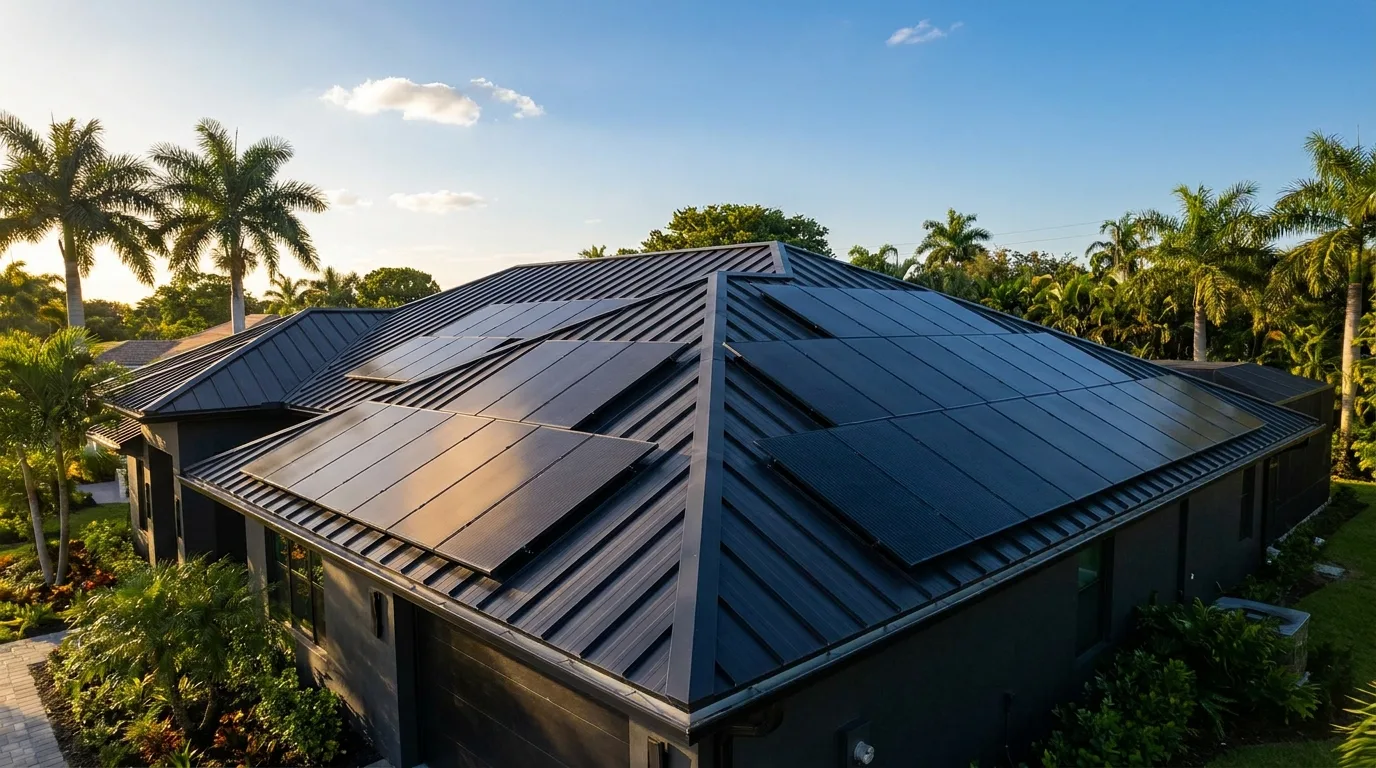
Florida roofs work hard. Sun, heat cycling, driving rain and storm exposure all shorten service life, and insurers have become far less tolerant of older roofs. Many homeowners find themselves needing a new roof while a perfectly healthy solar array sits on top of it.
Panels typically carry performance warranties of twenty-five to thirty years. A shingle roof in this climate will not match that. The mismatch is structural to the situation, not a failure of planning.
What the work involves
Removal and reinstallation, usually shortened to R&R, is a distinct job with its own sequence. Panels are disconnected and labelled, racking and flashing come off, the roof is replaced, then new flashing and mounts go in and the array is rebuilt and recommissioned.
The detail that matters is the penetrations. The old mounting points are not reused. New flashing is installed with the new roof, which is the entire reason the array has to come off rather than being worked around.
Treat any quote that proposes replacing a roof underneath a live array without removing it as a warning sign.
What drives the cost
Pricing is usually per panel, and the variables are predictable. Array size is the obvious one. Roof pitch and height affect access and labour. Tile roofs cost more to work on than shingle. Whether your original racking can be reused, or whether current code requires a different attachment, changes the materials bill.
There is also the question of storage and timing. Panels sitting on the ground are exposed and in the way, so the two trades need to be sequenced tightly. When one contractor handles both the roof and the solar, that coordination disappears as a problem.
Permitting and the inverter question
Reinstallation is generally permitted work. The attachment method is inspected as part of the roof permit, and in Florida that means current wind-load requirements apply to the new installation, not the ones in force when the array first went up. An older array may need different mounting hardware to satisfy current code.
It is also a sensible moment to assess the inverter. If the original inverter is near the end of its warranty, replacing it while the system is already down avoids a second mobilisation later.
How to avoid paying twice
The cleanest answer is sequence. If your roof has less remaining life than the solar warranty, replace the roof first and install solar onto a new surface. That is the single biggest avoidable cost in residential solar.
If the array is already up, the practical step is an honest assessment of remaining roof life before any storm damage forces the decision for you. We check roof condition as part of every solar evaluation precisely because this scenario is so common here.
Roof and solar on the same job?
We handle both, so the removal, the roof and the reinstallation are sequenced by one team rather than coordinated between two. Book a free assessment of your roof and array.
Frequently asked questions
How much does it cost to remove and reinstall solar panels in Florida?
It is normally priced per panel, and the main variables are array size, roof pitch and height, roof material, and whether the existing racking can be reused or current code requires different attachment hardware. We quote after inspecting the array and roof rather than from a table.
Can a roof be replaced without taking the panels off?
Not properly. The mounting points penetrate the roof surface, and new flashing has to be installed with the new roof. Working around a live array leaves the old penetrations in place, which is exactly where leaks start.
Does reinstallation need a permit?
Generally yes, and the attachment is inspected as part of the work. Current wind-load requirements apply to the reinstallation, not the ones in force when the array was first installed, so older systems sometimes need different mounting hardware.
Should I replace the inverter at the same time?
It is worth assessing. If the inverter is near the end of its warranty, replacing it while the system is already offline avoids paying for a second visit later. If it has years left, there is no reason to touch it.
How long does the process take?
It depends on array size and the roof itself. The panels come down, the roof goes on, and the array is rebuilt and recommissioned, so the solar work happens either side of the roofing work. Sequencing matters more than raw speed, which is easier when one company runs both.