
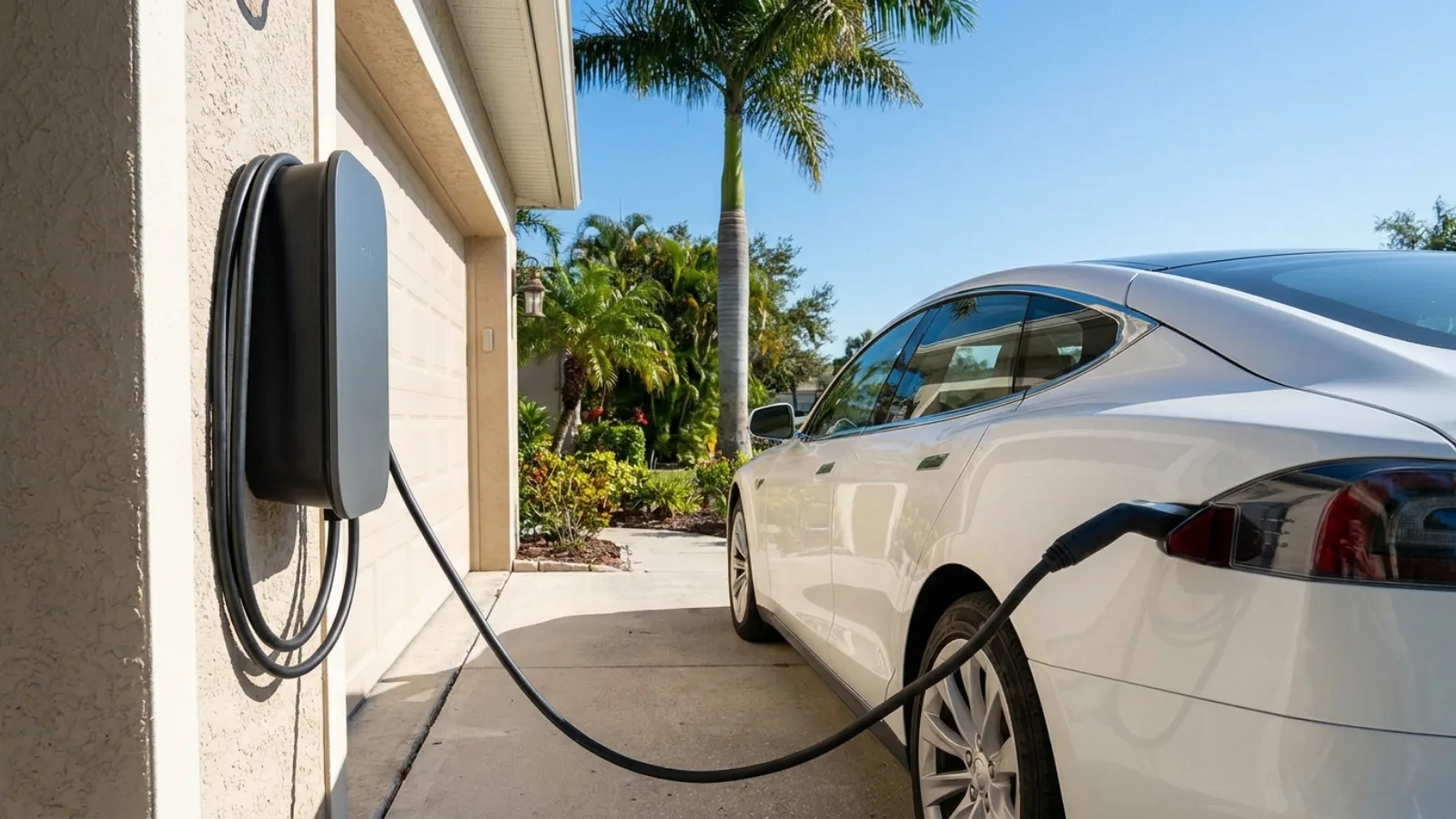

Do You Need a Permit for an EV Charger in Florida?
Short answer: yes, a hardwired Level 2 EV charger requires an electrical permit and an inspection in Florida, because it is a new dedicated circuit on your service panel.
Quick answer: Any hardwired charger, and in most jurisdictions any new 240-volt receptacle installed for a charger, requires a permit and inspection. A charger simply plugged into an existing, code-compliant outlet does not.
A Level 2 charger is one of the largest continuous loads most homes will ever add. It runs at high current for hours at a time, which is exactly the condition that exposes undersized wiring and overloaded panels. That is why the permit exists, and why an inspector will look at the panel as much as at the charger.
What the installation involves
| Step | What happens | Who handles it |
|---|---|---|
| Load calculation | Existing service capacity assessed against the new continuous load | Electrician |
| Permit application | Electrical permit for the new circuit, and for a service upgrade if required | Installer, on your behalf |
| Circuit installation | Dedicated breaker, correctly sized conductors, conduit and disconnect where required | Installer |
| Charger mounting | Unit mounted and terminated per the manufacturer listing | Installer |
| Inspection | Inspector verifies conductor sizing, breaker, bonding and mounting | Building department |
The things that catch people out
- Panel capacity, not charger capacity. Many Florida homes are on 150-amp service. Adding a 48-amp continuous load to a panel already running central air, a pool pump and an electric range often does not calculate out.
- Continuous load derating. EV charging is a continuous load, so the circuit is sized at 125 percent of the charger rating. A 40-amp charger needs a 50-amp circuit.
- Outdoor installations need the right enclosure. Florida humidity, salt air near the coast and driving rain all matter. Outdoor units need appropriate ratings and mounting.
- Load management can avoid a service upgrade. Where the panel is tight, a load management device that throttles charging when other loads are running is often cheaper than upgrading the service.
- Unpermitted work shows up later. It surfaces at resale, during an insurance claim, and whenever any other permitted electrical work is inspected.
What we handle for you
We run the load calculation first, tell you honestly whether the existing service will carry it, pull the permit, install the circuit and meet the inspector.
See what solar and battery storage would actually do for your home
We will pull your last 12 months of utility data, model your real consumption, and show you exactly what a system would cost and produce — no obligation, no pressure.
Frequently asked questions
Do I need a permit for a plug-in EV charger?
If it plugs into an existing, properly rated outlet, generally no. If a new 240-volt outlet or circuit is installed for it, yes.
Do I need to upgrade my panel for an EV charger?
It depends on your existing service size and current loads. A load calculation answers it. Many Florida homes need either an upgrade or a load management device.
Can my electrician skip the permit to save time?
Unpermitted electrical work creates liability for you, not for them, and it causes problems at resale and with insurers.
How long does EV charger permitting take?
It is usually one of the faster permits, since it is a single circuit, but timelines vary by jurisdiction.
Does a bidirectional charger need more than this?
Yes. A bidirectional charger can send power back, so it also needs utility interconnection approval, much like solar or a battery.