

.tce-blog{font-family:Inter,sans-serif;color:#1f2937}.tce-blog-hero{background:linear-gradient(135deg,#0959A8,#2FA824);padding:70px 55px;border-radius:30px;color:#fff;margin-bottom:40px}.tce-blog-author{display:inline-block;padding:10px 18px;background:rgba(255,255,255,.15);border-radius:50px;font-size:14px;font-weight:600;margin-bottom:20px}.tce-blog-hero h1{font-family:Poppins,sans-serif;font-size:50px;line-height:1.12;font-weight:800;color:#fff;margin:0 0 18px}.tce-blog-hero p{font-size:20px;line-height:1.7;max-width:820px;margin:0}.tce-blog-content{background:#fff;padding:2px 50px 50px;border-radius:30px;box-shadow:0 15px 50px rgba(0,0,0,.06)}.tce-blog-content p{font-size:18px;line-height:1.9;color:#4b5563;margin-bottom:25px}.tce-blog-content h2{font-family:Poppins,sans-serif;font-size:32px;font-weight:700;color:#0959A8;margin:50px 0 20px}.tce-blog-content h3{font-family:Poppins,sans-serif;font-size:22px;font-weight:700;color:#0e2a1d;margin:32px 0 12px}.tce-blog-content li{font-size:18px;line-height:1.85;color:#4b5563;margin-bottom:10px}.tce-highlight{background:#f7fbff;border-left:5px solid #2FA824;padding:25px;border-radius:0 14px 14px 0;margin:30px 0}.tce-highlight p{margin:0!important;font-size:18px!important;color:#1f2937!important}.tce-tbl{width:100%;border-collapse:collapse;margin:26px 0;font-size:16px}.tce-tbl th{background:#0959A8;color:#fff;text-align:left;padding:13px 15px;font-weight:700}.tce-tbl td{padding:12px 15px;border-bottom:1px solid #e5e7eb;color:#374151}.tce-tbl tr:nth-child(even) td{background:#f9fafb}.tce-cta{background:linear-gradient(135deg,#0959A8,#1f7a3d);border-radius:22px;padding:38px;color:#fff;margin:44px 0}.tce-cta h2{color:#fff!important;margin:0 0 10px!important;font-size:28px!important}.tce-cta p{color:rgba(255,255,255,.92)!important;margin:0 0 20px!important}.tce-btn{display:inline-block;background:#8ef0ae;color:#0e2a1d!important;text-decoration:none;font-weight:800;padding:13px 26px;border-radius:9px}.cpe2-faq{border-bottom:1px solid #e5e7eb;padding:20px 0}.cpe2-faq h3{margin:0 0 8px!important;font-size:19px!important;color:#0959A8!important}.cpe2-faq p{margin:0!important;font-size:17px!important}@media(max-width:768px){.tce-blog-hero{padding:40px 24px}.tce-blog-hero h1{font-size:32px}.tce-blog-content{padding:2px 22px 30px}}
{“@context”:”https://schema.org”,”@type”:”FAQPage”,”mainEntity”:[{“@type”:”Question”,”name”:”Is solar worth it on a house I only use part of the year?”,”acceptedAnswer”:{“@type”:”Answer”,”text”:”It can be, but it depends on how your utility treats exported energy and whether credits carry across to the months you are in residence. Occupancy pattern matters more than system size. We model it against your real usage before recommending anything.”}},{“@type”:”Question”,”name”:”What happens to the power generated while I am away?”,”acceptedAnswer”:{“@type”:”Answer”,”text”:”It is exported to the grid and earns a credit under your utility net metering programme. How long those credits persist, and what happens to an unused balance at the end of the annual period, varies between Florida utilities.”}},{“@type”:”Question”,”name”:”Will I still get a bill on an empty house?”,”acceptedAnswer”:{“@type”:”Answer”,”text”:”Almost certainly, yes. Most Florida utilities apply a fixed monthly customer charge regardless of consumption, and solar does not remove it. The energy portion can be offset; the fixed charge generally cannot.”}},{“@type”:”Question”,”name”:”Do I need a battery on a seasonal home?”,”acceptedAnswer”:{“@type”:”Answer”,”text”:”Not necessarily, but the reasoning differs from a year-round home. The question is what fails unnoticed during an outage while nobody is there, which usually means freezers, pool equipment and humidity control rather than comfort.”}},{“@type”:”Question”,”name”:”How do I know the system is working while I am away?”,”acceptedAnswer”:{“@type”:”Answer”,”text”:”Remote monitoring. Any system on a seasonal property should report production and faults to your phone so a problem in summer is not discovered on arrival months later. We set this up as standard.”}}]}
Solar for Seasonal and Snowbird Homes in Florida
A house you occupy for part of the year changes the solar maths in ways most calculators ignore. Sometimes it improves the case. Sometimes it undermines it.
Production does not stop when you leave
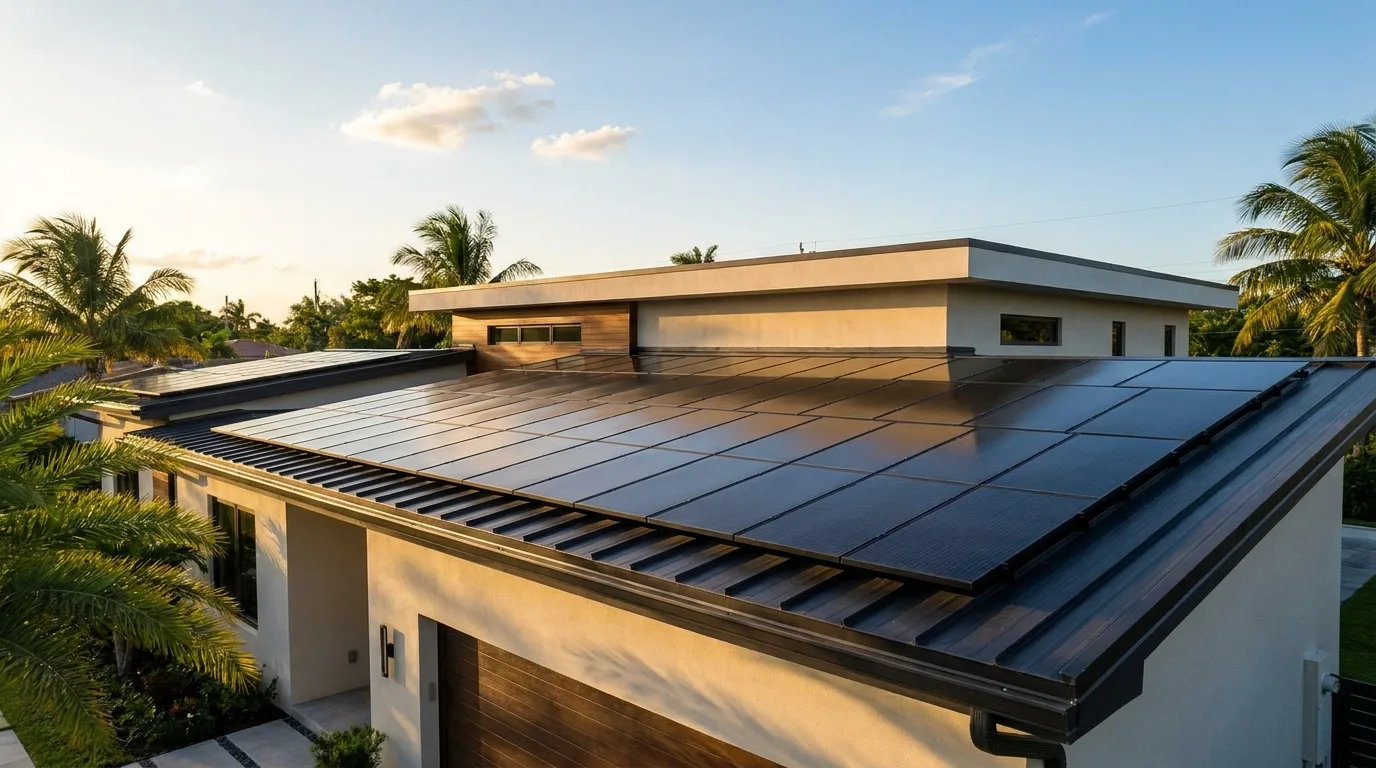
The array keeps generating whether anyone is home or not. In a seasonal property that means months of production with almost no consumption underneath it, so nearly everything generated is exported to the grid.
What that is worth depends entirely on how your utility handles net metering. Exported energy earns a credit, and whether those credits carry forward usefully to the months you are actually in residence is the single most important question for a seasonal owner.
Where the seasonal case gets complicated
Three things catch people out.
Minimum charges. Most Florida utilities apply a fixed monthly customer charge regardless of consumption. Solar does not remove it, so a vacant house still generates a bill.
Credit treatment. How long credits persist, and what happens to any balance at the end of the annual period, varies by utility. This detail decides whether summer production genuinely offsets winter usage.
Consumption pattern. If you are here in the cooler months and away through peak summer, you are generating most when you need least. That is not fatal, but it changes the payback calculation materially.
Why batteries look different for seasonal owners
For a full-time resident, storage is about riding out outages. For a seasonal owner the calculation shifts, because an outage while the house is empty has different consequences than one while you are in it.
A freezer full of food, a pool pump and a dehumidifier all matter when nobody is there to notice a failure. Humidity control in particular is why some seasonal owners value backup more than their year-round neighbours, not less.
Practical things to get right
Remote monitoring is not optional on a property you cannot see. Any system installed on a seasonal home should report production and faults to your phone, so a failed inverter in June is not discovered in November.
Tell your insurer. A roof-mounted array is a change to the property and should be disclosed, particularly on a home that sits unoccupied for long stretches.
Plan for storm season. If the house is empty through the summer, agree in advance who inspects the array after a named storm and what triggers a call.
Own a seasonal home in Florida?
We will model production against your actual occupancy pattern and your utility’s credit rules, and tell you honestly whether the numbers work.
Frequently asked questions
Is solar worth it on a house I only use part of the year?
It can be, but it depends on how your utility treats exported energy and whether credits carry across to the months you are in residence. Occupancy pattern matters more than system size. We model it against your real usage before recommending anything.
What happens to the power generated while I am away?
It is exported to the grid and earns a credit under your utility net metering programme. How long those credits persist, and what happens to an unused balance at the end of the annual period, varies between Florida utilities.
Will I still get a bill on an empty house?
Almost certainly, yes. Most Florida utilities apply a fixed monthly customer charge regardless of consumption, and solar does not remove it. The energy portion can be offset; the fixed charge generally cannot.
Do I need a battery on a seasonal home?
Not necessarily, but the reasoning differs from a year-round home. The question is what fails unnoticed during an outage while nobody is there, which usually means freezers, pool equipment and humidity control rather than comfort.
How do I know the system is working while I am away?
Remote monitoring. Any system on a seasonal property should report production and faults to your phone so a problem in summer is not discovered on arrival months later. We set this up as standard.