

.tce-blog{font-family:Inter,sans-serif;color:#1f2937}.tce-blog-hero{background:linear-gradient(135deg,#0959A8,#2FA824);padding:70px 55px;border-radius:30px;color:#fff;margin-bottom:40px}.tce-blog-author{display:inline-block;padding:10px 18px;background:rgba(255,255,255,.15);border-radius:50px;font-size:14px;font-weight:600;margin-bottom:20px}.tce-blog-hero h1{font-family:Poppins,sans-serif;font-size:50px;line-height:1.12;font-weight:800;color:#fff;margin:0 0 18px}.tce-blog-hero p{font-size:20px;line-height:1.7;max-width:820px;margin:0}.tce-blog-content{background:#fff;padding:2px 50px 50px;border-radius:30px;box-shadow:0 15px 50px rgba(0,0,0,.06)}.tce-blog-content p{font-size:18px;line-height:1.9;color:#4b5563;margin-bottom:25px}.tce-blog-content h2{font-family:Poppins,sans-serif;font-size:32px;font-weight:700;color:#0959A8;margin:50px 0 20px}.tce-blog-content h3{font-family:Poppins,sans-serif;font-size:22px;font-weight:700;color:#0e2a1d;margin:32px 0 12px}.tce-blog-content li{font-size:18px;line-height:1.85;color:#4b5563;margin-bottom:10px}.tce-highlight{background:#f7fbff;border-left:5px solid #2FA824;padding:25px;border-radius:0 14px 14px 0;margin:30px 0}.tce-highlight p{margin:0!important;font-size:18px!important;color:#1f2937!important}.tce-tbl{width:100%;border-collapse:collapse;margin:26px 0;font-size:16px}.tce-tbl th{background:#0959A8;color:#fff;text-align:left;padding:13px 15px;font-weight:700}.tce-tbl td{padding:12px 15px;border-bottom:1px solid #e5e7eb;color:#374151}.tce-tbl tr:nth-child(even) td{background:#f9fafb}.tce-cta{background:linear-gradient(135deg,#0959A8,#1f7a3d);border-radius:22px;padding:38px;color:#fff;margin:44px 0}.tce-cta h2{color:#fff!important;margin:0 0 10px!important;font-size:28px!important}.tce-cta p{color:rgba(255,255,255,.92)!important;margin:0 0 20px!important}.tce-btn{display:inline-block;background:#8ef0ae;color:#0e2a1d!important;text-decoration:none;font-weight:800;padding:13px 26px;border-radius:9px}.cpe2-faq{border-bottom:1px solid #e5e7eb;padding:20px 0}.cpe2-faq h3{margin:0 0 8px!important;font-size:19px!important;color:#0959A8!important}.cpe2-faq p{margin:0!important;font-size:17px!important}@media(max-width:768px){.tce-blog-hero{padding:40px 24px}.tce-blog-hero h1{font-size:32px}.tce-blog-content{padding:2px 22px 30px}}
{“@context”:”https://schema.org”,”@type”:”FAQPage”,”mainEntity”:[{“@type”:”Question”,”name”:”Are solar panels covered by homeowners insurance in Florida?”,”acceptedAnswer”:{“@type”:”Answer”,”text”:”A permanently roof-mounted array is generally treated as part of the dwelling and typically falls under the dwelling portion of a policy. That is the usual pattern rather than a guarantee, and coverage varies between Florida carriers. Confirm the specifics with your insurer in writing.”}},{“@type”:”Question”,”name”:”Does a hurricane deductible apply to solar damage?”,”acceptedAnswer”:{“@type”:”Answer”,”text”:”Florida policies often carry a separate hurricane deductible calculated as a percentage of insured value rather than a flat amount, and it generally applies to storm-related damage including the array. Your policy documents set the terms.”}},{“@type”:”Question”,”name”:”What documentation should I keep?”,”acceptedAnswer”:{“@type”:”Answer”,”text”:”Permit and final inspection approval, the structural engineering letter, equipment invoices with model and serial numbers, commissioning data, dated photographs, and your production monitoring history. The production record is the most commonly missing and often the most useful.”}},{“@type”:”Question”,”name”:”Is it safe to inspect my own panels after a storm?”,”acceptedAnswer”:{“@type”:”Answer”,”text”:”No. A damaged array can remain energised even when it appears to be offline. Do not walk a storm-damaged roof and do not handle wiring. Photograph from ground level and have an installer assess it.”}},{“@type”:”Question”,”name”:”Should I tell my insurer I have solar?”,”acceptedAnswer”:{“@type”:”Answer”,”text”:”Yes. An array is a change to the property and should be disclosed. Doing it at installation, rather than at claim time, avoids an avoidable argument about whether the system was covered at all.”}}]}
Hurricane Damage to Solar Panels: What Florida Homeowners Should Know
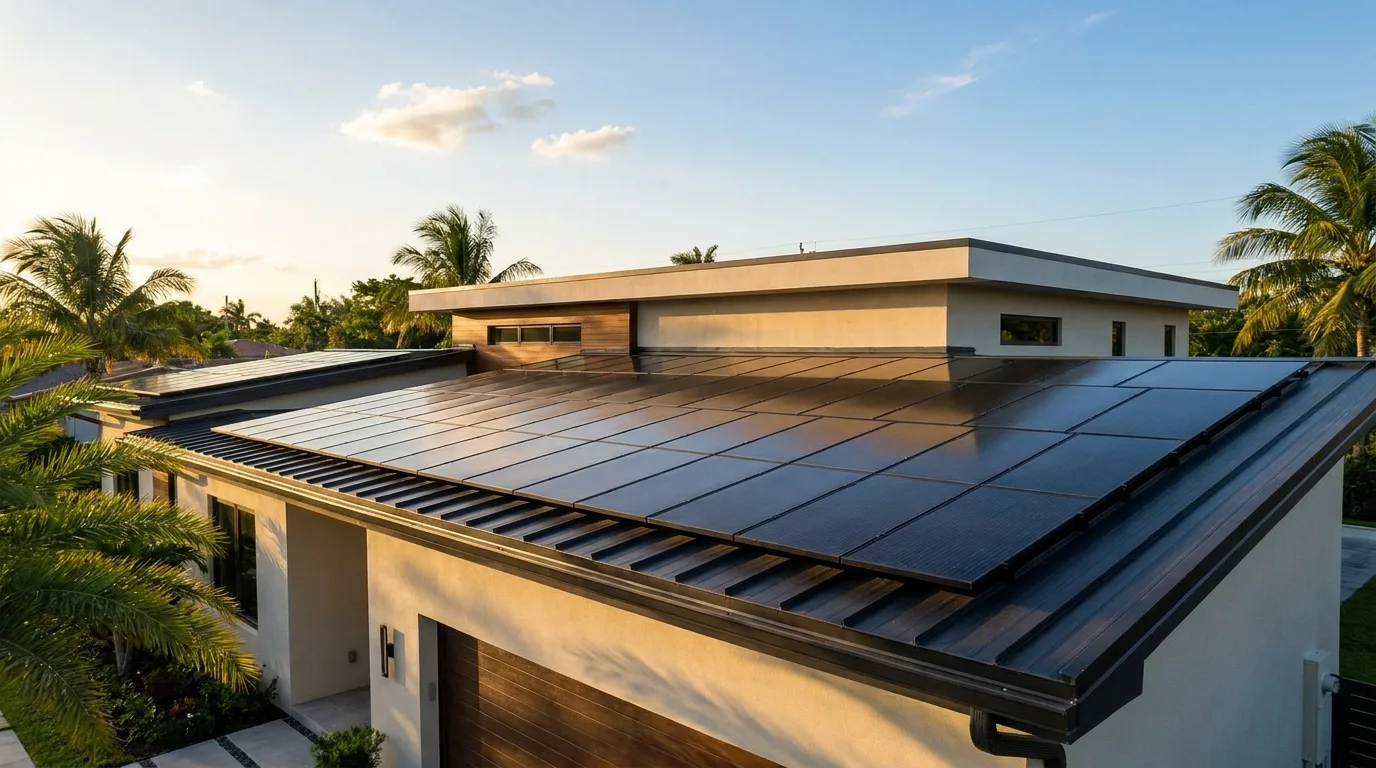
Solar arrays generally come through Florida storms better than people expect. When damage does happen, what matters is documentation, and most of that work is done before the storm arrives.
How arrays usually fail, and how they usually do not
Properly engineered arrays are rarely torn off by wind alone. Florida permitting requires attachment designed to the wind loading at your address, and that engineering is reviewed before installation.
Damage, when it occurs, more often comes from impact. Wind-borne debris cracks glass. A failing tree limb lands on a module. Water intrusion through a compromised roof shows up around mounting points.
The pattern matters because it shapes what you should be photographing afterwards, and what an adjuster will be looking for.
How solar is usually treated by insurers
A permanently roof-mounted array is generally treated as part of the dwelling rather than as separate contents, which means it typically falls under the dwelling portion of a homeowners policy. Ground-mounted systems are sometimes handled differently.
That is the general pattern, not a guarantee about your policy. Coverage, deductibles and hurricane-specific provisions vary significantly between Florida carriers, and Florida policies often carry a separate hurricane deductible calculated as a percentage of the insured value rather than a flat sum.
We install and repair solar; we are not insurance advisers. Confirm how your array is treated with your carrier in writing, before you need to know.
The documentation to assemble now
Claims are won on records that already exist. Keep somewhere retrievable: the permit and final inspection approval, the structural engineering letter, equipment invoices with model and serial numbers, commissioning data, and dated photographs of the installed array.
Production history is the most overlooked item. A monitoring record showing normal output before the storm and reduced output after it is strong evidence that something changed, and it is far more persuasive than a description.
What to do after a storm
Safety first. A damaged array can still be energised. Do not walk a storm-damaged roof and do not handle disconnected wiring. If modules are cracked or conductors are exposed, treat the system as live until an installer confirms otherwise.
Then document before anything is moved or tidied. Photograph from ground level, including wide shots that establish context. Note the date and time. Record what your monitoring shows.
Report promptly. Policies carry notice requirements, and a delayed report is one of the easier reasons for a claim to be questioned.
Reducing the risk before the season
An annual inspection ahead of hurricane season is the practical measure. Fasteners, flashing and racking condition are all checkable, and a loose mount found in May is a minor repair rather than a claim in September.
Overhanging limbs are worth dealing with for the same reason. So is confirming your attachment method matches what the permit specified, particularly on an array installed by a company no longer trading.
Want your array checked before storm season?
We inspect attachment, flashing and production performance, and give you a written record you can keep with your policy documents.
Frequently asked questions
Are solar panels covered by homeowners insurance in Florida?
A permanently roof-mounted array is generally treated as part of the dwelling and typically falls under the dwelling portion of a policy. That is the usual pattern rather than a guarantee, and coverage varies between Florida carriers. Confirm the specifics with your insurer in writing.
Does a hurricane deductible apply to solar damage?
Florida policies often carry a separate hurricane deductible calculated as a percentage of insured value rather than a flat amount, and it generally applies to storm-related damage including the array. Your policy documents set the terms.
What documentation should I keep?
Permit and final inspection approval, the structural engineering letter, equipment invoices with model and serial numbers, commissioning data, dated photographs, and your production monitoring history. The production record is the most commonly missing and often the most useful.
Is it safe to inspect my own panels after a storm?
No. A damaged array can remain energised even when it appears to be offline. Do not walk a storm-damaged roof and do not handle wiring. Photograph from ground level and have an installer assess it.
Should I tell my insurer I have solar?
Yes. An array is a change to the property and should be disclosed. Doing it at installation, rather than at claim time, avoids an avoidable argument about whether the system was covered at all.